
Erasmus+ Project in INS Alfons Costafreda
Es mostren els missatges amb l'etiqueta de comentaris Teacher Trainig. Mostrar tots els missatges
Es mostren els missatges amb l'etiqueta de comentaris Teacher Trainig. Mostrar tots els missatges
diumenge, 13 de desembre del 2015

dimarts, 28 de juliol del 2015
Discussion in class
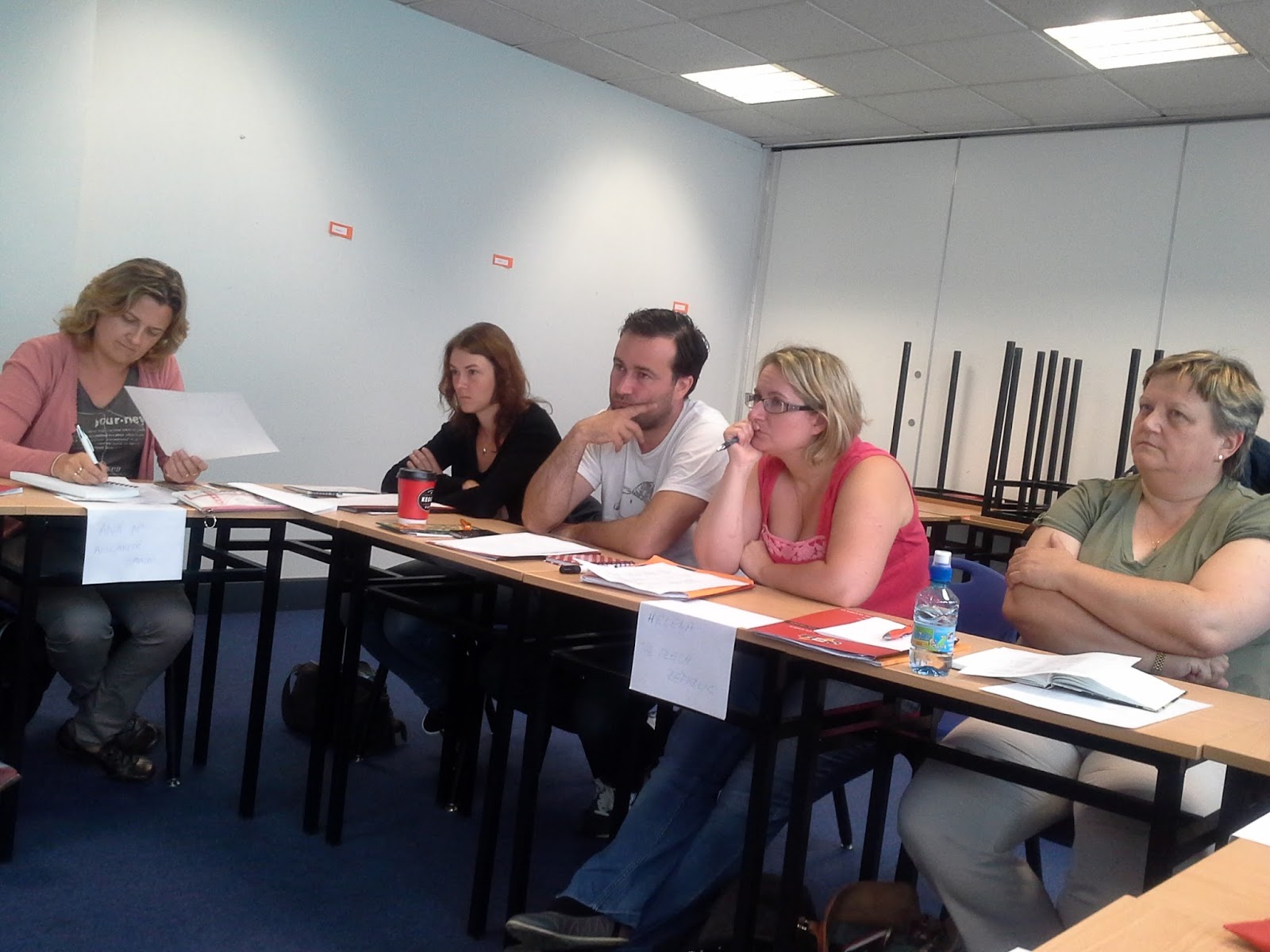
Today we had to observe the class of other teachers in CES School. My mission today is to observe Gerry's class.
It was an advanced group, with high interests and habilities for debate and discussion, Gerry has made it possible with authentic material from a webpage: idebate.org.
idebate is done by the International Debate Education Association (IDEA). As they say in their own webpage, the association gives young people a voice through education, debate and by raising their awareness about worldwide issues. The webpage is a compliation of different blogs, sorted by debate subjects.
Gerry has taken some texts from the web page, about the military institution. The students had to sort them depending on the agreement or disagreement with the military coups (skim reading). Then, in a most precise reading, they had to find some informations in the texts.
The next step is the debate in small groups, by presenting some questions, as a preparation for the debate in the large group.
The language focus at the end is dedicated to the idioms, with an exercice on wich students have to gess the meaning from the context.
It was an advanced group, with high interests and habilities for debate and discussion, Gerry has made it possible with authentic material from a webpage: idebate.org.
idebate is done by the International Debate Education Association (IDEA). As they say in their own webpage, the association gives young people a voice through education, debate and by raising their awareness about worldwide issues. The webpage is a compliation of different blogs, sorted by debate subjects.
Gerry has taken some texts from the web page, about the military institution. The students had to sort them depending on the agreement or disagreement with the military coups (skim reading). Then, in a most precise reading, they had to find some informations in the texts.
The next step is the debate in small groups, by presenting some questions, as a preparation for the debate in the large group.
The language focus at the end is dedicated to the idioms, with an exercice on wich students have to gess the meaning from the context.
divendres, 24 de juliol del 2015
Task Based Learning
As it has been said many times, one of the most important things of the methodology which is in the base of CLIL is the increase of the STT (Student Talking Time). But it is also important that students realise the sense of the activitiy. The context helps, but if the activity has a certain objective, the motivation of the students is higher. This is the sense of the TBL (Task Based Learning).
In TBL, learners doing tasks will be making free use of whatever English they can recall to express the things that they really want to write in the process of achieving the task goal.
The features of a good task are:
- Engages the learner's interest
- The meaning is the primary focus
- There is a goal or an outcome
- The success is judged in terms of outcome
- Completion is a priority
- The activity relates to real world activities
There are different types of TBL, for example: listing, comparing, ordering and sorting, comparing, problem solving, sharing personal experiences, creatice tasks,...
As all the activities we have seen, the TBL has also different components or steps:
- The pre-task: Introduction of the topic. Teacher explores the topic with the class, highlights usefull words and phrases, and helps students understand task instructions and prepare for the task.
- The task cycle:
- Language focus:In TBL, learners doing tasks will be making free use of whatever English they can recall to express the things that they really want to write in the process of achieving the task goal.
The features of a good task are:
- Engages the learner's interest
- The meaning is the primary focus
- There is a goal or an outcome
- The success is judged in terms of outcome
- Completion is a priority
- The activity relates to real world activities
There are different types of TBL, for example: listing, comparing, ordering and sorting, comparing, problem solving, sharing personal experiences, creatice tasks,...
As all the activities we have seen, the TBL has also different components or steps:
- The pre-task: Introduction of the topic. Teacher explores the topic with the class, highlights usefull words and phrases, and helps students understand task instructions and prepare for the task.
- The task cycle:
- Students do the task in pairs or small grups.
- Planning: Students prepare to report to the hole class (orally or writing) how they did their task, what they decided or what they discovered.
- Report: Some groups report to the class or exchange written reports and compare the results. After that, it can be a comparison between the groups, or a competition.
- Analysis: Students analyse specific features of the text or transcript
- Practice: Teacher conducts practice of new phrases ocurring during or after analysis.

 << This is a picture of some of us with the teacher Samantha in te middle.
 How can I adapt this to my classes?
In a philosophy class, we could change a bit the sense of the activity, and ask for a philosophical product. For example, to design a product which can make people happy, in order to discuss about what is happiness and how we can achieve it. Or a perfectly fair city, to think about justice.
dijous, 23 de juliol del 2015
Going through the subject, step by step
Today we had to do an observation task. I had to observe how Eric, anothe teacher of CES, developes the differents steps of a lesson. His class has a good level, and the subject was quite interesting: Beauty and the own image.
At first, Eric introduces the topic trough a video, in which appears a professional model giving advice to hopeful models about industry requirements.
The second step is to personalise the topic, by hanging on the walls some pictures of people who have sent headshots into model agencies. The students, in groups, have to give the own opinion about which of them are good or bad and why.
Then there is a discussion in class about the diferent opinions, based on a group of sentences given by the teacher. The students decide if they are good or bad arguments.
The fourth step is a pre-reading activity, the vocabulary check: The teacher gives some words in different sentences, and the students guess the meaning.
The reading activity is about the enigma of beauty. The students do a skimm reading to get the general idea of the article.
The next step is another vocabulary activity, post-reading, of some idiomatic expressions in the text.
Now is the turn to speak. The teacher gives the students some questions about their own experience, and where they can practice the idioms learnt before.
After the speaking, Eric introduces a listening activity, with some shocking pictures about differents things taht people of differents cultures do do to change their image: lip suctioning, neck ring, skull binding, lip plate, mutation, and foot binding. After speaking around some questions about the pictures, Eric shows the students a clip about a photographer who has been photographing women with bound feet in China as a aprt of a project. The students have to listen to it twice and answer some comprehension questions.
At the end, a gap activity. Students have to read some texts about other ways to change the own image. Each group reads a different text, and after, Eric makes diferents groups to share the information. After taht, discussion about which one ist the worst and why.
In conclusion, a very interesting subject, carefully developed in steps, and motivating for the students.
At first, Eric introduces the topic trough a video, in which appears a professional model giving advice to hopeful models about industry requirements.
The second step is to personalise the topic, by hanging on the walls some pictures of people who have sent headshots into model agencies. The students, in groups, have to give the own opinion about which of them are good or bad and why.
Then there is a discussion in class about the diferent opinions, based on a group of sentences given by the teacher. The students decide if they are good or bad arguments.
The fourth step is a pre-reading activity, the vocabulary check: The teacher gives some words in different sentences, and the students guess the meaning.
The reading activity is about the enigma of beauty. The students do a skimm reading to get the general idea of the article.
The next step is another vocabulary activity, post-reading, of some idiomatic expressions in the text.
Now is the turn to speak. The teacher gives the students some questions about their own experience, and where they can practice the idioms learnt before.
After the speaking, Eric introduces a listening activity, with some shocking pictures about differents things taht people of differents cultures do do to change their image: lip suctioning, neck ring, skull binding, lip plate, mutation, and foot binding. After speaking around some questions about the pictures, Eric shows the students a clip about a photographer who has been photographing women with bound feet in China as a aprt of a project. The students have to listen to it twice and answer some comprehension questions.
At the end, a gap activity. Students have to read some texts about other ways to change the own image. Each group reads a different text, and after, Eric makes diferents groups to share the information. After taht, discussion about which one ist the worst and why.
In conclusion, a very interesting subject, carefully developed in steps, and motivating for the students.
dimarts, 21 de juliol del 2015
Let students talk!
Icebrakers
Yesterday we learnt
som methods to start talking about a subject or to introduce an issue
(Ice Breakers). The one I liked the most was a work in groups of
three, which consisted in talking about what is a good student, or a
good teacher (not all groups had the same subject). We had to draw it
and put some adjectives in a piece of paper, which would be later put
in discussion with the rest of the class and hanged on the class
wall.
As Philosophy
teacher, I'm very concentrate on activities that promote the
discussion. So I think that in my Philosophy classes I could do
something similar to this one, jaust changing the subject. For
example, we could talk about what is a good philosopher, a good man
or woman, a good leader, and so on. The students will have to use
adjectives or sentences to describe the habilities that are required
to be good in some of these things.
Questions with no
answers
Another way of
starting talking is just by showing a picture, and make the students
make questions about it, that they would like to know about what is
happening in the picture. As nobody, even the teacher, doesn't know
the answer, the students become aware that there is no right answer
and that they have to make hypothesis. Of course, the activity can
continue by writing a text, or reading alternative texts about it
with missing information in two versions (student A and B), so that
they have to communicate to complete the information that they don't
have.
Problems with
speaking
It happens very
often that students doesn't speak in class, or they have serious
difficulties to start speaking, because they feel the pressure of
being tested, they have fear of mistakes, or just no interest on the
subject. Stuart gave us some advices:
- To give them time
to practice in little groups and to prepare what they were going to
say.
- To personalize the
topic (making them talk about their own opinion or about things that
they like).
From speaking to
writing
Once we have
introduced the topic by pictures, or we made a discussion obout a
subject, it's important to work with important vocabulary before
starting writing. The student can also write in pairs, and correct
themselves with a correction code.
How to introduce
vocabulary
The main idea of the
methodology we are learning is that vocabulary is always learned in
context. The first thing we have to decide is which vocabulary is
receptive (they have to understand it, but no to use it), and which
is productive (they have to be able to use it).
The different steps
for vocabulary activities could be:
1. To present the
vocabulary in context
2. To ask for
definitions
3. To compare the
own definitions with the partners
4. To compare the
definition with the solution
5. To correct
6. To do
associations in order to check if the comprehension is right.
What does it have to do with Philosophy?

I think that really a lot. A very important task of Philosophy is to make things clear and, like Socrates did, to find good definitions of some important words like: Hapiness, Justice, Freedom, Goodness, Pleasure, and so on. The difference is that in Philosophy there is not a definitive answer or definition, so students will have to search for good definitions and also for good arguments to defend it.
dilluns, 20 de juliol del 2015
First steps into the project
I
am in Dublin with other teachers from other
countries, in order to improve my English and to learn new
methodologies to use in class. My objective is to be able to teach
Philosophy in English in certain levels in my High-school.
I'm at the CES
School Dublin, following the course Training for Teachers (CLIL), and
my teachers are Stuart and Samantha. This is Stuart in action:


They
are all teachers coming from different countries like Greece, Italy,
Portugal, Germany, Chec Republic and Spain. Most of the time, we
have to take the role of a student, just to feel how a student feels
doing some activities.
The
main point of these methodology (CLIL) is based on learning in
context, so that the context gives more sense to the language and
improves its learning process.
One of
the most important instruments to get this point is to let the
students the main role of the class, and to promote an active
learning, for example, in using different skills and habilities in an
exercise. We draw, speak, listen, collaborate, and move around the
class very often.

Each day we work with a different skill, as you can see on the timetable of the course:

During the following posts I will try to explain more aspects of the course and, of curse, of Ireland and Dublin.
Subscriure's a:
Missatges (Atom)