divendres, 18 de desembre del 2015

BLOG CONTEST – 1st BATXILLERAT


The blog Catalonia Beyond Appearances  has been chosen as the winner of the 1st Batxillerat Blog Contest. Students had to create a blog about Catalonia covering topics such as festivities, traditions, food and landmarks. This activity was carried out with the help of Anthony Wheeler our English language assistant. Congratulations to you all! 
 
http://cataloniabeyondappearances.blogspot.com.es/


divendres, 11 de desembre del 2015

FUN PLAYS


Yesterday morning some of our students attended the performance of a play by English Theatre Company - ETC. Our 1st and 2nd ESO students had a really great time watching Just Good Friends, a play about friendship, dreams and misunderstandings, and our 1st and 2nd Batxillerat students just loved Me TV, a satirical look at mindless media. 


Both plays were pitched at the right level of English for our students, and, as is always the case with ETC plays, they were extremely funny. The best part of it all was when our students stepped onto the stage to perform with the actors. They simply loved that, and the audience did too!


Once more, we would like to thank ETC for sharing such enjoyable moments with us.


dijous, 5 de novembre del 2015

BRITISH CULTURE CLASS


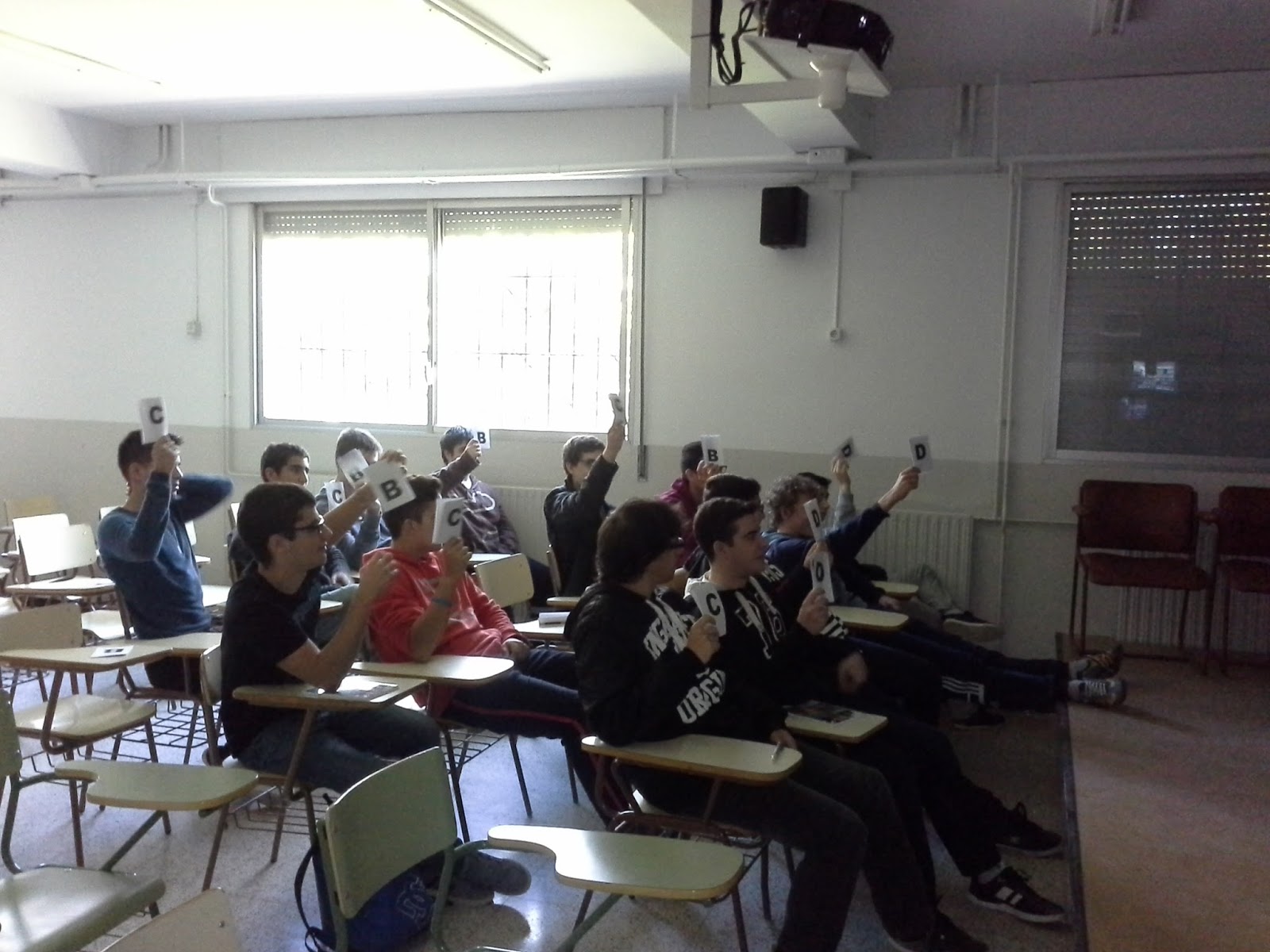
Last Wednesday 4 November the students in CFGM SMIX and CFGM Gestió Administrativa enjoyed a fun and interactive lesson offered by Burlington Books about various aspects of British culture and life. 


Our students had lots of chances to participate in the fast-moving and very funny talk Cristina gave us.

At the end of the class our students the chance to take part in a quiz to test their knowledge about British culture and win very nice prizes!


divendres, 23 d’octubre del 2015

Estrenem auxiliar de conversa


foto de Ins Alfons Costafreda.
Tenim el goig de presentar-vos l'Anthony Wheeler, un estudiant de Llengües Modernes de la Universitat de Cambridge, Anglaterra, que fa d'auxiliar de conversa en anglès al nostre centre durant aquest curs escolar. A banda d'actuar d'ambaixador de la seva llengua i cultura al nostre país, la seva tasca principal consisteix a potenciar i millorar la competència oral del nostre alumnat.
L'Anthony intervé a totes les etapes educatives que es cursen al centre -ESO, Batxillerat i Cicles formatius- i col·labora tant a les classes de Llengua anglesa com a les d'altres matèries que ofereixen una part del seu temari en anglès com és el cas de Física i Química i Educació Física a l'ESO, Economia al Batxillerat o algunes unitats formatives de Comerç Internacional al cicle superior d'Administració i finances.
Tant alumnes com professors valorem molt positivament la tasca de l'Anthony a la nostra comunitat educativa, la qual de ben segur serà el màxim de profitosa, i li desitgem una estada entre nosaltres feliç i memorable.


dimarts, 28 de juliol del 2015

Discussion in class

Today we had to observe the class of other teachers in CES School. My mission today is to observe Gerry's class.
It was an advanced group, with high interests and habilities for debate and discussion, Gerry has made it possible with authentic material from a webpage: idebate.org.
idebate is done by the International Debate Education Association (IDEA). As they say in their own webpage, the association gives young people a voice through education, debate and by raising their awareness about worldwide issues. The webpage is a compliation of different blogs, sorted by debate subjects. 
Gerry has taken some texts from the web page, about the military institution. The students had to sort them depending on the agreement or disagreement with the military coups (skim reading). Then, in a most precise reading, they had to find some informations in the texts.
The next step is the debate in small groups, by presenting some questions, as a preparation for the debate in the large group.
The language focus at the end is dedicated to the idioms, with an exercice on wich students have to gess the meaning from the context.


dilluns, 27 de juliol del 2015

Books and Authentic Material

We have talked in class about the advantages and disadvantages of the course book, in contrast with the "realia", the authentic material.

The course book can be a useful material to practice some grammar or lexic aspects on the last step of the language focus. But to start talking and building sense around the language, the authentic material is more motivating.

In addition, the course book is the same for all students, so, as they have the same information, there are no information gaps to fill, and no information to share.

Authentic material could be a set of material objects, pictures, videos, or ...  also books! We can talk about real books in the real world. We talked about James Joyce because Stuart showed us a book of James Joyce. He told us that he was dead, and we started to talk in the past tense.

Real books of real authors in real libraries 

There where I live, the Trinity College, is surrounded by books, real books. There are so many, that they don't seem real. Isn't the old library like a magical and fictive place?


How many books may be there?


Who wrote them?


When were they written?


What are they about?


Who did the magical work of sorting, ordering and puting them in those infinite shelves?


Did the students read some of them?


In which books were they more interested?


What did they learn about them?


One of those students might be the philosopher George Berkeley (1687-1753), who was a student and scholar of Trinity College and one of its senior academicsis widely regarded as Ireland's greatest philosopher and among the world's top philosophers. His most influential philosophical thesis, "Immaterialism," has, since the eighteenth century, attracted considerable attention in the fields of epistemology and metaphysics.
The main influences on his early work are generally regarded to be John Locke and Nicolas Malebranche, and in later life he was influenced by writers in the Platonist tradition. He had considerable influence on the works of many important philosopers including David Hume and John Stuart Mill.


There is a library next to the old one, that is named after him: the Berkeley libary.

It is in this one where now the students read and study in the present tense, in the present continuous, in a very different way as Berkeley and his colleges did, about very different subjects, but, I'm sure, with the same emotional and theorethical problems and questions.

A last question: Why did  Arnaldo Pomodoro make this sculpture called 'Sphere with Sphere' (1982) to illustrate the entracnce of the library?